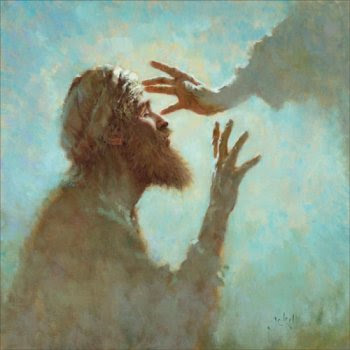
Thursday, August 13, 2009

Response to comment on "Healing"


An Anonymous Friend said...

Honestly, I don't know how I feel about healing. I questioned my girlfriend about Isaiah 53, and she pointed me to Matthew 8:16-17. Matthew clearly interprets the "griefs" and "sorrows" in Isaiah 53:4 as "sicknesses."

"When the even was come, they brought unto him many that were possessed with devils: and he cast out the spirits with his word, and healed all that were sick: that it might be fulfilled which was spoken by Isaiah the prophet, saying, Himself took our infirmities, and bare our sicknesses."

I will check back in a couple of days to see if you have replied. Take care!

_________________________

The passages in question (ESV):
__________________________
Matthew 8:14-17

14 And when Jesus entered Peter's house, he saw his mother-in-law lying sick with a fever. 15 He touched her hand, and the fever left her, and she rose and began to serve him. 16 That evening they brought to him many who were oppressed by demons, and he cast out the spirits with a word and healed all who were sick. 17 This was to fulfill what was spoken by the prophet Isaiah: “He took our illnesses and bore our diseases.”

__________________________
Ish 53:4-5

4 Surely he has borne our griefs
and carried our sorrows;
yet we esteemed him stricken,
smitten by God, and afflicted.

5 But he was wounded for our transgressions;
he was crushed for our iniquities;
upon him was the chastisement that brought us peace,
and with his stripes we are healed.

___________________________

I appreciate folks stopping by with comments!

I looked back at my original post and it should be clear via the 2nd and 3rd point I made in my blog entry that I believe Christ's penal substitutionary atonement on the cross did vanquish both our sin debt and the effects of the fall/ death on our world. That includes sickness. However, my point is that those benefits are not provided to us in full until our death and glorification in the world to come with our ressurected body. We can all see that our acceptance of Christ's work in place of our own has secured our eternal life, yet we still have to endure in this mortal shell for a generation before sin is no longer our enemy for practical purposes. In that same way, we can bank that the cross did secure our physical perfection, but only after a season on this planet where we struggle with deep afflictions, shall we realize it in sum.

The whole broad narrative of Scripture is blatantly obvious about the multitude of painful trials that believers will encounter. We are encouraged to rest in our hope (that is Christ) and stand strong thru them - we are NOT called to take select verses out of context and create entire man-centered theologies around a false idea that true believers will never experience hardship.Seeing the entire redemptive plan means that Isaiah 53 could have lots to say about healing and it wouldn't affect my view. Jesus is sufficient for all things, physical healing included, but that does not mean that we inccur all the benefits immediately - just the opposite, we are to be patient as we wait for the ressurection of the saints and the ultimate realization of the victory that Christ already purchased.

As for the correspondence between Isaiah 53 and Matthew 8...I can see that Matthew makes reference to the Isaiah passage and he is obviously talking about physical sickness. However, in my blog I did not deal with 53:4, I dealt with 53:5. I think that the two are completely different sentences and separate thoughts/ prophecies about the coming Messiah (the suffering servant).

Verse 4 (together with the Matthew version) seems to be telling of a man who would heal the sick, cast out demons, and perform other miracles while his own people ignored his power and made plans to make him suffer. This is exactly what happened to Christ, he came and proved that he was who he claimed he was via his miracles - yet the Jews despised him and plotted to have him killed.

Verse 5 on the other hand is the one that actually refers to healing and is usually taken out of context to speak of physical healing. The language here (transgression and iniquities) is obviously related to our sin nature and not our sickness. When that verse mentions "peace" it is clear that the meaning is primarily "spiritual peace with God" not "physical peace from suffering" - why is it so clear? I think that a plain reading is pretty forthright, but another way to see the clarity is to once again look at all of the Bible and open one's eyes to the suffering that the apostles endured in the early church...

When Paul tells Timothy to have some wine (1 Tim 5:23), its good for the stomach, that implies that Timothy's probably had stomach aches. Thats a simple example of the fact that even the earliest saints were dealing with sickness and mortal fragility while they remained alive.

It is so easy to get captured by the word-faith movement and the teaching on healing - it appeals to our dark and self-centered heart..."oh, you mean that I don't have to be sick or poor if I truly believe, wow that Jesus guy is pretty sweet" Instead we should see the biblical portrait, which is..."Christ is worthy no matter my physical or financial condition, he alone is God and he is a good and merciful God who only does what is right and just and loving - even if I don't understand."

If you build your faith on prosperity theology, your foundation will be swept away when great calamity hits your life. If you build your house on the sovereignty of our Lord, you will endure all storms - it may still be scary when they strike, but you will pull through intact!"

Wednesday, August 12, 2009

Interview Outcome


Lots of people are probably interested in how my interview went yesterday - so I figured that it would be easiest to give the rundown on here and then simply direct folks to this link.

I think that I did very well in the interview itself. I met with 3 of the top folks at the Court of Appeals Chief Executives Office. I wasn't flabbergasted by any questions and I felt they were overall impressed. At the end of the interview they asked me if I had any questions and thats when things when south.

I asked them about the daily routine, the hours, the chance for upward mobility, etc...

They were very honest and they gave me a lot to think about. Here is the situation as it looks now.

PRO to this job - $375.00 a month net income increase (thats a minivan)

CONS to this job:
- take away $100.00 of that increase immediately for my bus pass to get there
- add 1 to 1 ½ hours away from my family each day due to a longer commute
- no upward mobility (they were very honest about the fact that the court rarely has new vacancies and that they rarely hire from internal candidates even when they do have openings)
- suspension of civil service protections (I would work at the pleasure of the Chief Judge, so all the benefits of government job security are out the window)
- need to go buy dress pants, shirts, and shoes (no more shorts and tees)
- travel on Mother's Day to judicial conference every other year
- no cost of living increases ( Court is cutting budget they explained and they are about to stop giving both "step" increases and annual cost of living increases)
- working as a "gopher" for 12 appellate judges who see themselves as demi-gods (obviously fun)

So, as you can see I am not too excited about this job prospect. I have decided to continue with the application process if they call me in for the second interview. If they do eventually offer me the job, I will accept on the condition that they reimburse me the cost of my bus pass each month (hey, its going green isn't it?!?)

Thanks to everyone who was praying for me. God doesn't always answer in the affirmative and it might be that the uneasy feeling I got yesterday about this job is His way of saying "I have something better around the bend." I am not sure yet of the choice I'll make in this situation - but I pray that He will continue to be with me for my joy and His glory.

Tuesday, August 11, 2009

'Stillborn' 1.1.-Pound Baby Wakes Up Just Before Funeral


He is still in the miracle business...

ASUNCION, Paraguay — A baby boy born 16 weeks prematurely was declared dead by doctors at a hospital in Paraguay only to wake up in time for his funeral wake hours later.

Dr. Ernesto Weber, head of pediatric care at the state-run hospital in the capital of Asuncion, said the baby weighed just 1,1 pounds when he was born.

"Initially, the baby didn't move, he practically didn't have any respiratory reflexes, nor did we hear a heartbeat and, as a result, we declared a premature fetus of 24 weeks dead," Weber told Reuters Television.

The family was given a death certificate and a cardboard box with the baby's name scribbled on the outside which served as a makeshift coffin.

But when the family took him from the hospital to prepare him for his funeral, the unbelievable happened.

"I opened the box and took the baby out and he cried. I got scared and I said "the baby's crying" ... and then he started moving his arms, his legs and I got scared, we got very scared," said one member of the family, Liliana Alvarenga.

Hours after the baby's death had been declared he was found to be alive. The hospital has begun an investigation and the baby is now in a stable condition in an incubator.

http://www.foxnews.com/story/0,2933,538721,00.html?loomia_ow=t0:s0:a16:g2:r2:c0.192287:b27050028:z0

GIVE HIM PRAISE!

My iPod


Sometimes people ask me about the music I am listening to on my iPod. I have lots of different stuff on there. Much of my life inside the headphones does not revolve around music at all. I listen to lots of podcasts (free talk radio from Apple). You can get a podcast for just about any subject, I listen to lots of preaching.

Currently, my iPod hosts sermons from John Piper, John MacArthur, Mark Driscoll, and Allistar Begg. Additionally, I have several teaching programs downloaded, including stuff from Greg Koukl, RC Sproul, and William Lane Craig. All of these resources have been one part of growing my faith – namely, they grew my theological understanding and critical thinking skills. I am very grateful for the use I have gotten out of my iPod. I paid $200 for it back in 2006 – great investment!

Of course, I do have some music stored away as well. It may seem cheesy, but I have lots of Christian music. I am not one of those people who thinks that a believer can’t listen to secular music, it is my own personal conviction to distance myself from most music that isn’t overtly Christian. Music tends to bring back memories for me and I don’t need to spend my day thinking about drunk fighting (rock music) or promiscuity (hip hop). To keep my head uncluttered, I listen to lots of explicitly religious stuff.

I would say that my two favorite “artists” are Indelible Grace and LeCrae. IG is actually a group of folks that sprung out of Belmont University. They have an amazing knack for setting old hymms to modern arrangement. It is really laid back, yet deep music. Best of all, they are very sound in their lyrics, one can learn a lot about what Scripture says by the songs they sing. It’s a great way to reinforce daily time in the Word and prayer. The other artist is a Christian rapper named LeCrae. He is able to put catchy beats in the background of some insanely profound rhymes. His work is so Christo-centric and right-on, John Piper has teamed up with him for several projects.

Before I post the webpages of these 2 artists, let me invite you (my awesome reader) to send me a comment with your favorite Christian artist/ song. I appreciate it!

http://www.igracemusic.com/

http://www.lecrae.net/

Monday, August 10, 2009

Interview


All-

Please include me in your prayers tonight or tomorrow morning (if you remember). I am heading to a job interview at 1:15pm tomorrow. I will be trying to get a new job at the Court of Appeals downtown. It isn't extremely well-paying - but it should provide us the minivan that we need.

Ultimately, I want to be where God wants me to be. I think he left me at the Archives for these past few years (despite the pay and atmosphere) because it is a place that allows me to listen to lots of podcasts (whereby I gained alot of knowledge and faith) and because it is a workplace where religion is regularly discussed (providing a door for the gospel to be proclaimed).

I feel in my heart that he is ready for me to move on - I hope that isn't just me being ready to move on! So, please pray that I will do well in the interview and that I am able to trust in His grace whatever the outcome of His perfect will for my life turns out to be.

Thanks.

Quote 08/09/2009


"Man is nothing: he hath a free will to go to hell, but none to go to heaven, till God worketh in him to will and to do his good pleasure"

George Whitefield to John Wesley

Saturday, August 8, 2009

Challies Controversy


There has been lots of controversy about a recent post by well-known reformed blogger Tim Challies in the past couple of days. I encourage you to read his post here:
http://www.challies.com/archives/christian-living/the-religious-hell-hole-1.php

Tim is attempting to address the very difficult question of "do babies that die go directly to heaven?" I was actualy asked that question myself less than a week ago by a 12 year old boy. In my opinion, it has no easy answer. The best we can say is that Scripture does not appear to be clear on the issue.

On one hand we have the issue of original sin and the sentence that it brings to our eternal soul w/o Jesus intervention to elect us. Taken with logical reformed consistency, it seems that elect babies who die go to heaven while non-elect babies that die do not. On the other hand, many pastors (including Piper and MacArthur) make arguments of inference from select scripture to say that God mysteriously saves all babies since they lack a natural ability to understand their sin.

I am unsure of my position. I don't see concrete evidence in the Bible of the "all babies go to heaven" stance - yet, I see enough potential evidence to keep my mind unmade on the matter. Personally, if I ever had to speak with someone who experienced such a loss regarding this, I would side with Pipers argument. I think that it would bring comfort without harming any of the essential doctrines of grace.

However, a recent comment by someone about this at "22 Words" struck me...they said:

"The real question is would you still love Jesus even if He did send some or all babies to hell?”

How true. If you find yourself answering in the negative to that question then you have a serious problem with understanding sovereignty, authority, Lordship, and submission. We must remember that God is the creator and we are the created. He has ultimate power in deciding to do what he will with us. And by definition, all of his decisions are good. They may not always seem good to our limited, finite, temporal, and fallen minds - but, we must trust that they are.

God is a God of grace and I hope that he makes a special provision, although not explicit in Scripture, for babies/ children/ and mentally handicapped who don't have the mental faculty to see his natural or special revelation to go straight to heaven. However, if he does not make such allowance and he treats those persons the same as us all (elect and non-elect without any basis from ourselves) then I will still worship and adore him. It is a painful idea, until I remember that we all deserve hell and that it is only the grace of God which saves any from eternal torment. As we see our own condition clearly (baby or not) we get a much bigger appreciation for the love that God displays in saving any rebel against him. Take comfort in that amidst the difficult questions like this one.

Friday, August 7, 2009

You might be a Presbyterian if...


1. You can spell supralapsarian.

2. When asked to name the twelve apostles you say Matthew, John, James, Andrew, Peter, Nathaniel, Phillip, Simon, Thomas, Augustine, Luther and Calvin.

3. You used to be a Baptist.

4. You started drinking ("in moderation" of course) after you left the Baptist church and became a Presbyterian.

5. When the spirit comes upon you in power, you don't raise your hands and shout Hallelujuah, rather you scratch your chin, turn to your neighbor and whisper "hmmm, . . . that was a good point."

6. You think fencing has something to do with the Lord's Supper instead of swords.

7. You've considered church discipline for people who watch the NFL on Sunday afternoon.

8. They aren't "catholics," or even "Roman Catholics." They're "Papists."

9. Instead of going to prophecy conferences where they talk about Star-Trek eschatology and the mark of the Beast, you attend conferences on "life and culture", art, social justice and other high- brow things like that. Afterwards, you go to the local pub and talk about enlightenment philosophy and soteriology over a pint of dark beer.

10. You attend a church which has a name closer to "Grace Covenant Fellowship" rather than a church that calls itself something like "The Washed In The Blood, Berean, Bible-Believing, Charismatic Tabernacle and Worship Center".

Thursday, August 6, 2009

Healing - part 2


I had a few extra thoughts on the subject...

- We should ALWAYS pray for the healing of those who are sick. It is explicitly commanded in James 5:14. Yet, we must not take the next verse (15) to mean that everyone who gets sick WILL be healed. Verses 10 and 11, just above, make it plain that many will suffer and endure affliction. They also make it clear that we are to endure that hardship with steadfast praise.

- Instead of praying for healing (or anything else) as if we have authority over God to affect him into action, we should pray in the way that the Lord Jesus taught us. In Luke 22:42, we read that Jesus makes his request AND he trusts that God will ordain the outcome in whichever way is best. I hear alot of people say that praying "in His will" is weak prayer, but thats how Christ prayed and he certainly wasn't a man of weak prayer.

- And lastly, I want to post this great article which I recently read by Dr. Sam Storms. It is a far better resource than I could ever write, please take a look at it. This question will hit all of us at some point. If you can get your mind biblically prepared now - the turmoil might be less when life forces you to ponder the issue.
_______________________

Why God Doesn't Always Heal

God loved the apostle Paul. Yet God sovereignly orchestrated his painful thorn in the flesh and then declined to remove it, notwithstanding Paul's passionate prayer that he be healed.

We are not apostles. Yet, as his children, no less so than Paul, God loves us too. We don't know the nature of Paul's thorn, but each of us has undoubtedly suffered in a similar way, and some considerably worse. We, like Paul, have prayed incessantly to be healed. Or perhaps knowing of a loved one's "thorn" we have prayed for them. And again, like Paul, God declined to remove it. Why?


It's hard to imagine a more difficult, confusing, and controversial topic than why God chooses not to heal in response to the intercessory pleas of his people. I don't profess to have all the answers, but I think I've got a few. I'm sure that this meditation will provoke many to anger and frustration, while others, I pray, will find a measure of comfort.

In the final analysis, virtually everything about healing remains a mystery. I don't mind saying that I'm weary of those who claim to reduce healing to a formula or a manageable cause and effect phenomenon in which we can know with certainty why some are healed and why others are not. I've labored in this meditation to avoid falling into that trap. That said, I would like to suggest that the reason why many are not healed may possibly be answered in any one of seven ways.

(1) Although we must be careful in giving more weight to the role of faith than does the NT itself, we also must be willing to acknowledge that occasionally healing does not occur because of the absence of that sort of faith that God delights to honor.

This does not mean that every time a person isn't healed it is because of a defective faith or that if only a more robust and doubt-free faith were in exercise that healing would inevitably follow. But it does mean that faith is very important. How can we conclude otherwise in view of the many texts in which healing is closely linked to someone's faith? I hope you'll take the time to pause and read these passages: Matthew 9:22, 28-29; 15:28; Mark 2:5,11; 5:34; 9:17-24; Mark 10:52; Luke 17:19; Acts 3:16; 14:8-10; James 5:14-16.

In my book on spiritual gifts I asked the question: "Why did Jesus emphasize faith?" Neither he nor his Father need it. They could have orchestrated life such that something other than faith would be the condition on which they would heal. They are not hampered or hindered by the faithlessness or prayerlessness of the sick person or those who pray for his/her healing. The reason is this: faith glorifies God. Faith points us away from ourselves to him. Faith turns us away from our own power and resources to his. Faith says, "Lord, I am nothing and you are everything. I entrust myself to your care. I cling to you alone. My confidence is in your word and character no matter what happens."

Faith is not a weapon by which we demand things from God or put him in subjection to us. Faith is an act of self-denial. Faith is a renunciation of one's ability to do anything and a confession that God can do everything. Faith derives its power not from the spiritual energy of the person who believes, but from the supernatural efficacy of the person who is believed: God! It is not faith's act but its object that accounts for the miraculous.

(2) Sometimes healing does not occur because of the presence of sin for which there has been no confession or repentance. James 5:15-16 clearly instructs us to confess our sins to one another and pray for one another that we may be healed. Again, please do not conclude from this that each time a person isn't healed it is because he/she has committed some specific sin of which they have refused to repent. But in some cases this is undoubtedly true.

(3) Although it sounds odd to many at first hearing, healing may not happen because the sick don't want it to happen. Jesus asked the paralyzed man in John 5:6, "Do you want to be healed?" What on the surface may appear to be a ridiculous question is, on further examination, found to be profoundly insightful.

Some people who suffer from a chronic affliction become accustomed to their illness and to the pattern of life it requires. Their identity is to a large extent wrapped up in their physical disability. They enjoy their dependency on others and the special attention it brings them. In some instances they don't want the responsibilities that would come with being healthy. This is not a common phenomenon, but it does happen in a few cases.

(4) We must also consider the principle articulated in James 4:2, where we are told that "you do not have, because you do not ask." The simple fact is that some are not healed because they do not pray. Perhaps they pray once or twice, and then allow discouragement to paralyze their petitions. Prayer for healing often must be prolonged, sustained, persevering, and combined with fasting.

(5) Some are not healed because the demonic cause of the affliction has not been addressed. Please do not jump to unwarranted conclusions. I am not suggesting that all physical disease is demonically induced. Of course, it is interesting, is it not, that in Paul's case God used "a messenger of Satan" to inflict the thorn. There is also the case of the woman in Luke 13 "who had a disabling spirit [or, a spirit of infirmity] for eighteen years. She was bent over and could not fully straighten herself" (Luke 13:11). According to Jesus, "Satan" had "bound" her (Luke 13:16; see also Acts 10:38).

It takes considerable discernment, time, and patience to determine if an illness has a demonic cause, together with even greater commitment to praying for that individual and leading them to address the reasons for their spiritual oppression. When these factors are ignored, healing may not be forthcoming.

(6) We must also consider the mystery of divine providence. There are undoubtedly times and seasons in the purposes of God during which his healing power is withdrawn or at least largely diminished. God may have any number of reasons for this to which we are not privy, whether to discipline a wayward and rebellious church or to create a greater desperation for his power or to wean us off excessive dependence on physical comfort and convenience or any number of other possibilities. If this leaves you confused, that's why it's called a mystery!

But what must we say when the problem isn't the absence of faith or the presence of a demon or the refusal to repent or the failure to pray or a lack of desire? How then do we account for on-going physical affliction, as in Paul's case? I strongly urge you to carefully read the next point.

(7) Often times there are dimensions of spiritual growth and moral development and increase in the knowledge of God in us that he desires MORE than our physical health, experiences that in his wisdom God has determined can only be attained by means or in the midst of or in response to less than perfect physical health. In other words, healing the sick is a good thing (and we should never cease to pray for it), but often there is a better thing that can only be attained by means of physical weakness.

More important to God than our physical health is our spiritual holiness. This isn't to say the body isn't important. God isn't a Gnostic! He values and has redeemed our bodies and now dwells within them as his eternal temple. But while we live in this corrupt and decaying world, inner and spiritual conformity to the image of Christ often comes only at the expense of or at least simultaneous with physical deterioration and suffering (see 2 Cor. 4:16-18).

Let me personalize this principle. If I believe Romans 8:28, that God sovereignly orchestrates all events in my life for my ultimate spiritual good (and preeminently for his ultimate glory), I can only conclude that, all things being equal, if I'm not healed it is because God values something in me greater than my physical comfort and health that he, in his infinite wisdom and kindness, knows can only be attained by means of my physical affliction and the lessons of submission, dependency, and trust in God that I learn from it.

In the final analysis, we may never know why a person isn't healed. What, then, ought to be our response? In the first place, don't stop praying! Some people find this difficult to swallow. Many times I've been asked: "Why should Paul bother to pray for release from something that God wills to inflict?" The answer is because Paul didn't know what God's will was in this particular case until such time as God chose to make it known. And neither do you or I with regard to any particular illness that we may suffer.

If the Lord had never said in response to Paul's prayer, "No, it isn't my will that you be relieved of this thorn," Paul would have been justified, indeed required, to continue to pray for his healing. I once heard Jack Taylor put it this way: "Never cease praying for healing until you are shown otherwise either by divine revelation or death!" If you are able to discern, as did Paul, through some prophetic disclosure or other legitimate biblical means that it is not God's will now or ever to heal you, you may cease asking him to do so. Otherwise, short of death itself, you must persevere in prayer. You never know but that God's ultimate and long-term will for you is complete healing after he has for a season accomplished his short-term sanctifying purpose.

In Paul's case, the only reason he ceased asking for deliverance was because God, in effect, told him to shut up! "No, Paul. I'm not going to heal you. It isn't my will in this instance that you be set free from this affliction. Rather, I have a higher purpose in view: your humility and my Son's glory manifest in the context of your on-going weakness."

To which Paul, in effect, replied: "O.K., Lord, I'll shut up and submit to your merciful purpose in my life. I know you love me and desire what is ultimately of greatest good for my spiritual growth. Therefore, my prayer now is that you maximize in me the beneficial effects of this pain. Don't let me miss out on any spiritual good that might come my way from this malady. Teach me everything I need to know and sustain me that I might be a platform for the glory of Christ and a source of comfort to other suffering saints."

I'm sure there are other ways to account for why God chooses not to heal, but I trust that these have proven helpful. There is much I do not know about this matter, but of this I'm quite certain: God's grace is sufficient in all circumstances so that we, "for the sake of Christ" (2 Cor. 12:10a), might learn that in our weakness his power is made perfect!

Wednesday, August 5, 2009

A bigger cross...


"We all need a bigger cross...a cross that not only forgives us, but also draws us to obedience and gives us the assurance that God’s ways are always the best ways - even when we don't understand."

Thanks to Tim and his controversial post for the inspiration of this quote.

http://www.challies.com/archives/christian-living/the-religious-hell-hole-1.php

Tuesday, August 4, 2009

Healing


I have some friends (folks who get my blog delivered to their e-mail each time I hit "post") who sometimes discuss their beliefs on healing. I disagree with their take on what the Bible has to say about healing and I feel compelled to air my opinion in response to their interpretation. I want to start by saying that they are fine people and strong Christians. They were used in a mighty way by God to bring me to saving faith in Christ and I do not write this "rebuttal" out of any animosity towards them. They are sincere believers with whom I simply don't agree. Because I think that dialogue about important issues is essential - I give you their view and my response. Comments welcome, especially from the friends of whom I write.
__________________________

My friends said:

"The second part of our belief in Healing is a little harder to explain.

And like I said, I don't claim to understand it 100%, but hey isn't that what faith is about?

Boiled down, we believe that Isaiah 53:5 is proof that Christ took our sickness on the Cross.
Christians believe that Christ died on the Cross for our sins, but if you read the rest of that verse you find that Jesus also died for our diseases. He was reversing the Fall of Man, and that would include sickness.

In our family, the husband is our Bible Scholar.
I personally have a hard time interpreting and focusing on the text. So most of what I know about Healing I have learned from sermons from Pastors like Andrew Wommack.
When we pray a sickness off us, it isn't much different then when people talk about praying for the sick. We just have a different mindset.

We claim Healing once and only once. The same way we ask to be forgiven once and only once.
From there, we begin to thank God for the Healing that is taking place.

And sometimes believing it is hard.
I think that Healing is even harder in America because we are bombarded by negative information about health all the time. There is always an epidemic on the news and WebMD makes us all sure we are dying from something.

It's a rule in our house that when one of us isn't feeling well, we cannot go online or watch TV. We try not to talk to people about it who don't believe in Healing.
It just helps keep the negative disbelief out of our minds.

We also are big on not speaking death over our house.

The Bible says that there is power in the tongue and that you are either speaking Life or you are speaking Death at all times.

For example, when someone says, "Little Billy has the flu. I hope Susie doesn't get it since we were over there last night. I think they shared a cup!", we simply say, "She won't get sick, she's covered by the blood of Jesus."

Some people are sensitive so we don't say it to them. We just claim it.

We believe that God took All the disease and sickness with him and that we are healed of any problem. That's where we lose people.

We acknowledge that people of extreme faith die of illness. That sometimes, it seems their claiming didn't work. And as I said, I don't have all the answers. I do believe that it has to do with having unbelief.

You know the verse that talks about moving mountains with faith as small as a mustard seed? I believe that you only need a teeny tiny bit of faith, but just a teeny tiny bit of unbelief mixed in there will block that belief. That's why we think its so important not to let our fast technology scare us out of claiming.

See, sounds kinda crazy huh?

We have lost friends over this and a lot of people write us off when we tell them that we don't get sick.

But that's OK with me.

The proof is in the fact that we don't get sick."
_________________________

My reply:

1) Healing is mysterious, I agree. No one can understand the will or actions of God perfectly - but we can come pretty close by looking at the whole of his redemptive plan in Scripture.

2) I do not deny that Christ's sacrifice on the cross conquered sickness once and forever. But, I don't see evidence that this is immediately applicable anymore than our spiritual perfection is immediate. The effects of a fallen world plaque us until we die and pass on to be glorified and ushered into the presence of God. It is in that moment, when we leave this realm behind that the victory of Christ over sickness is realized for us. Check these passages:
1 Corinthians 15:52-53
1 Corinthians 13:12
2 Corinthians 5:2-4

3) The use of Isaiah 53:5 by charismatics to give "proof" that Jesus death on the cross was as much for physical healing as it was for spiritual rebirth falls flat when one looks at the context and the original language. The first part of the verse tells us what things that Christ healed us from. The context does not denote physical illness. Instead it clearly refers to our transgressions and iniquities. Physical illness is not a transgression nor an iniquity. It is obvious that the reference here is to sin. The word "healed" can only be properly interpreted when it is studied in light of its surroundings. In this case, it does not mean "healed from physical sickness" - instead, it appears to be used as a metaphor. Sin is our disease, Jesus heals us.

4) I suggest that one should stay away from preachers like Andrew Wommack. People like him, Kenneth Copeland, Benny Hinn, even Joel Osteen are not Christ-centered ministers. The gospel that they preach is a false one that elevates man to an absurd degree. They seem to preach Jesus as a means to an end, a slot-machine for our gain, instead of the all-powerful and sovereign God of creation who deserves our praise regardless of what he does for us or not. Jesus is our greatest treasure, he is our end - not health, wealth, or success...only Jesus. Those things may come, they may not - if he is our chief pleasure and our ultimate aim in this life, we have not wasted our existence. If, however, we see Christ as the way to get rich, healthy, and powerful we will miss out on the true joy of loving Him for Him and we will have wasted this life. Scripture is clear that greedy false prophets will come and deny the all-sufficiency of Jesus (2 Peter 2:1-3), but they will not escape final doom.

I suggest trying to listen to a few sermons from John Piper or John MacArthur. Most importantly - become a bible scholar for yourself. We ALL should (that means me and my family too).

5) I agree that the media and the world are very negative and that they can influence us to jump to conclusions and to overreact. Self-diagnosis via the web is a horrible thing.

6) The neo-pentecostal idea of "name-it, claim-it" or "speaking life and death" over oneself is a serious theological misunderstanding and honestly appears to border on turning biblical faith into some hocus-pocus mystical new age stuff. Proverbs 18:21 is the "proof-text" for this idea. However, as we again look at the context it seems clear that the writer is not being literal in verse 21 anymore than he is talking about actual fruit growing in ones mouth satisfying ones hunger (see verse 20).

The principle here is that our tongue can be used for edifying people or for breaking them down. Compare with Proverbs 12:18. This is certainly true. Our human nature stands in defiance to that old schoolyard poem...words can really hurt us.

7) Claiming things does not seem to make them happen. St. Paul, who authored most of the New Testament, was afflicted with an illness in 2 Corinthians 12 and he didn't seem to be able to pray it away. In fact God told him that this messenger of Satan should stay with him. Why would God do that? Why would he allow a man of amazing faith, a man begging to be relieved of his pain, to be tortured through physical sickness?...

Because God is not most ultimately concerned with us being in good health, financially well-off, or secularly successful. God is most concerned with his Name, he is most concerned with getting glory for Himself. That isn't conceited for a being who deserves it, its natural and good. He is the potter and we are the clay (Romans 9), he will mold us in whatever way he sees fit that he should receive the utmost glory and honor. This is borne out by Paul and the story of Job. Horrible, horrible things occur to Job and God patently allows Satan to do them. By that allowance, God ordains, even wills the action in some sense.

God is in control, despite what Andrew Wommack would say, and he will be gracious to whom he will be gracious (Exodus 33). The wind blows where it wills (John 3), not where we claim it should blow.

8) No one has all the answers, some unregenerate people receive miraculous healing and other people with great faith die. Even if claiming was true, it often does not seem to work. And why not? According to this theological mentality, it is due to a lack of faith and an abundance of unbelief in the one who needs the healing or the ones praying for that person . Malarkey!

Great saints of God are struck down by the fallenness of this world every day. Cancer kills grandmothers, lung disease racks godly women who never smoked a day in their life, children get leukemia and die even when their parents have raw and rug-burnt knees.

These things don't happen because the person didn't have enough faith to force Jesus into performing his magic healing trick. They happen because God sovereignly ordains them. He made all things and he has authority over creation, not us. Sure, he sometimes delegates specific authority to specific persons - but we are not all little-Gods. He alone is God. He is all-wise and all-good. He is working all things (even the horrible ones) together for the good of his people. The ultimate good, that is eternal life and a inner man that resembles Christ more and more each day.

God will work differently in each of us all to achieve that goal. Some will be rich, some poor. Some will be healthy, some terminally ill. Some will be CEOs, some will be pizza boys. God works in all things that his people will be taken care of (Romans 8:28) and he works in all our lives to bring us to a place where he will be most glorified in us and we will be most satisfied in him.

9) Everyone gets sick, and ear infection is a sickness. There may be many reasons that someone does not usually get sick. They might eat well, exercise regularly, have good genetics, decide that a common cold isn't worth a trip to the doctor, etc...To say that the "proof is in the pudding" again brings the center of attention to ones own abilities (we are good claimers with lots of faith) and not Gods ruling hand/ deserved glory. We must learn to take our eyes off this world and our own work and say with Job:
"The Lord gives and the Lord takes away. Blessed be the name of the Lord" (1:21)

10) In conclusion...Christianity is not a religion of magic words, its a relationship of trust even when the relief doesn't come. Faith is not best explained as "what Jesus can do for me" if I have enough of it, but as resting in what Jesus did for me that I might enjoy eternity with him and obey him forever. Sickness is not a consequence of ones lack of belief, its a consequence of this natural order and it is always a thing allowed by God for ultimate good. Gods number one priority is not us, it is himself and thats the way it should be. The "full gospel" isn't - its actually a false gospel.
_____________________________

Thats all I felt that I needed to get off my chest. I realize that my friends posted their views with the request that:

"... if you don't agree or believe the same way, please keep your negative comments away."

...thus, I have not responded on their blog nor have I named them and few people who read this blog could figure out who they are even with some effort. Ultimately, I don't feel that I was negative in my post, unless you think that disagreeing is inherently negative. My hope is that I have provided some food for thought and some lively discussion fodder.

Please hit me up with some feedback. I don't claim to know it all, I just claim to try and have good biblical reasoning behind my views - what do you think?

Protect Thyself


This past Monday was my first "Protect Thyself" seminar. A few months ago, a friend who serves as a houseparent at Eagle Ranch asked me to come teach his (5) middle-school boys self-defense. I talked it out with him over a few weeks and the result was a class called "Protect Thyself."

The essence of this one-day period of instruction is to give the student a introduction to practical ways they can defend themselves both physically (against assaults and abductions) and spiritually (against the temptations which spring from our nature, the world, and the devil).

I spent the physical portion talking about how to stay safe and out of harms way before transitioning into some drills that showed them ways to defend themselves if it came to that. They loved the hands on interaction and the sense of accomplishment. Then I spent the spiritual section focusing on the gospel (always central) and the biblical portrait of spiritual combat as we discussed the weapons we have in that battle (prayer, the word, social action...)

I can't post many pictures because I need the kids parent's premission to put them on-line. Here are a few of me and John (my houseparent friend) demonstrating a choke defense.

Now that I have one of these under my belt, I am looking to open this up to interested youth groups and ministries. It is also great for women AND men (if they can push past that male pride we all have). If you know of anyone interested, shoot me a message.

glover4088@bellsouth.net

I have a blog up that touches on this right now, I may get a full webpage in the future - if it takes off. Thanks!

http://protectthyselfsd.blogspot.com/


Quote of the Week - 8/2/09


"Ignorance of God and of ourselves is the great principle and cause of all our disquietments; and, this ariseth mostly not from want of light and instruction, but for want of consideration and application."
John Owen

Thursday, July 30, 2009

This Present Darkness


Ephesians 6:12
For we do not wrestle against flesh and blood, but against the rulers, against the authorities, against the cosmic powers over this present darkness, against the spiritual forces of evil in the heavenly places.


Recently, a friend at work asked me if I read much Christian fiction. I admitted that I didn't read much fiction at all. I have a hard time losing myself in stories that don't reflect reality (or at least the deep themes of reality), plus all fiction pretty much fails to meet the bar set by Tolkien in LotR.

My friend went on to suggest that I read a novel called "This Present Darkness" by Frank Peretti. I politely said "ok, thanks" and put the issue out of my mind. The next day I found a $25.00 gift card to Books-A-Million in my dresser drawer. Apparently, I received it for Christmas, stuffed it away, and absolutely forgot it existed. Imagine my surprise at finding it - it truly was Christmas in July!

So today, after work, I stopped in to spend the gift card before I forgot about it again. I moved back to the Christian section and picked up "Death by Love" by Driscoll. It looked really good, but something in me put it back down. Then I grabbed a small booklet by J.I. Packer called "Affirming the Apostles Creed." Then, as I headed for the checkout, my mind flashed to the recent talk with my co-worker about the Peretti book. I went back to the Christian Fiction section (new territory for me) and looked around. I quickly found the book and next thing I knew I was buying it.

I came home tonight, spent time with the family, and then laid down at 11pm to read. I had no idea what this novel was about. However, my first indication of it being good was that it was published by Crossway. I am always pleased with the publishing decisions of the folks at Crossway. In shortly over an hour I had devoured the first 60 pages of this book. 60 pages which have been so powerful for me that I am sitting at the computer at 1am writing this blog.

"This Present Darkness" has started out in the fashion of C.S.Lewis' "The Screwtape Letters." An intense and gripping portrait of the world that lies under our visible arena. A place where angels and demons readily engage each us, entice us, and protect us. Yet, the supernatural characters in the book don't take front stage. The main player is a small town pastor who is unfailing in his proclamation of the gospel and unwavering in his prayer for the community - in the face of much hardship.

Granted I have a long way to go in this book, so my review is incomplete, but the first impression is a great one. I don't see any theological heterodoxes or heresies in the writing, I do see a strong stance by the pastor character for Christ, and the writing is fun and engaging. I would highly recommend this book to friends, even off of the little bit I have read. Has anyone else out there read the book? If so, what are your opinions - please no spoliers!


Reading this also reminds me to give a "shout-out" to my friend William "Doc" Woods. Doc is the author of a book which has similar structure. His "The Warfare of Doubting Thomas" is a great blend of his Catholicism and his years in the Navy. It is a worthy read as well. Plus any book with my name in the acknowledgements must be good right?!?

- OH, I forgot to mention the providence of this find. I am scheduled to teach a seminar to middle school boys at Eagle Ranch on Monday. It is a 6 hour class on physical and spiritual self defense. I am very able to do the physical part off the top of my head, but I have been praying for assistance on correctly discussing the world of spiritual combat. This book will certainly not be my textbook, but it was a good resource for visualization as I prepare. You can check out more about this grassroots venture at:
http://protectthyselfsd.blogspot.com/
I hope to evaluate the endeavour after my first seminar and potentially pitch the idea to local churchs. We'll see what God has in store.
Soli Deo Gloria

Wednesday, July 29, 2009

Missing Discipleship Group


Proverbs 27:17
Iron sharpens iron,
and one man sharpens another.


Last night I had to miss my weekly mens discipleship group. Something came up last minute at home with our photography business that kept me from going. As I reflected on missing, I found myself rather sad.

I have come to cherish the 2.5 hours of solid fellowship and study with 3 awesome guys from my church each week. It has been a "pit stop" in my life where I can refuel and retool. We have been studying "Gospel Christianity" by Tim Keller and I have learned alot about making the faith practical from that workbook.

More importantly, I have deeply benefited by sharing with and hearing from other men about our Christian walk in this life. It is nice to be able to bounce ideas off of other men and be better for it. This is my first regular mens group that actually delves into the Word for the glory of Christ. I am humbled to be a part of it.

I am ultimately very thankful for the iron in my life and I am looking forward to our next meeting so we can continue making each other better men through the power of the Holy Spirit.

Tuesday, July 28, 2009

Infant Baptism


I jut read a great post on infant baptism by Kevin DeYoung. I adopted reformed theology a couple of years ago, but it wasn't until the last few months that I began to attend a PCA church that teached padeobaptism. I thought this article was very good to summarize the position. I expect to have my 8 month old baptised pretty soon.

http://www.revkevindeyoung.com/2009/07/why-i-baptize-babies.html

One of the best things I get to do as a pastor is to administer the sacrament of infant baptism to the covenant children in my congregation. Before each baptism, I take a few minutes to explain why we practice infant baptism in our church. My explanation usually goes something like this:

It our great privilege this morning to administer that sacrament of baptism to one of our little infants. We do not believe that there is anything magical about the water we apply to the child. The water does not wash away original sin or save the child. We do not presume that this child is regenerate (though he may be), nor do we believe that every child who gets baptized will automatically go to heaven. We baptize infants not out of superstition or tradition or because we like cute babies. We baptize infants because they are covenant children and should receive the sign of the covenant.

In Genesis 15 God made a covenant with Abraham. This covenant was sealed with the sign of circumcision in Genesis 17. God promised to bless Abraham. For Abraham this meant two things in particular, offspring and land. But at the heart of the covenant was God’s promise that he would be a God to Abraham and his children (Gen. 17:7, 8).

Circumcision was not just a physical thing, marking out ethnic Jews. Circumcision was full of spiritual meaning. The circumcision of the flesh was always meant to correspond with circumcision of the heart (Rom. 2:25-29). It pointed to humility, new birth, and a new way of life (Lev. 26:40-42; Deut. 10:16; 30:6; Jer. 4:4; 6:10; 9:25). In short, circumcision was a sign of justification. Paul says in Romans 4:11 that Abraham “received the sign of circumcision as a seal of the righteousness that he had by faith while he was still uncircumcised.” God’s own interpretation of circumcision is that it was much more than just a physical sign for national Israel.

Remarkably, though, this deeply spiritual sign was given to Ishmael as well as Isaac, even though only Isaac was the continuation of the promised line. The spiritual sign was not just for those who already embraced the spiritual reality. It was to be administered to Abraham and his sons. Circumcision was not a simple equation. It didn’t automatically mean the recipient of the sign was in possession of the thing signified. Circumcision, like baptism, also pointed to belonging, discipleship, covenant obligations, and allowed for future faith that would take hold of the realities symbolized. Just as there were some in Paul’s day who were circumcised but not really circumcised (Rom. 2:25-29), some children of Abraham who were not truly children of Abraham (Rom. 9:6-8), so in our day there are some who are baptized who are not truly baptized. Children should be marked as belonging to the covenant, but unless they exercise saving faith, they will not grab hold of the covenant blessings.

Children today are baptized based on this same covenant with Abraham. Paul makes clear in Galatians 3 what Peter strongly suggests in Acts 2, namely that the Abrahamic covenant has not been annulled. It is still operational. In fact, we see the basic promise of the Abrahamic covenant running throughout the whole Bible, right up to the new heaven and new earth in Revelation 21.

Because sons were part of the Abrahamic covenant in the Old Testament and were circumcised, we see no reason why children should be excluded in the New Testament sign of baptism. Admittedly, there is no text that says “Hear ye, hear ye, circumcision replaces baptism.” But we know from Colossians 2:11-12 that baptism and circumcision carried the same spiritual import. The transition from one to the other was probably organic. As the Jews practiced proselyte baptism, that sign came to be seen as marking inclusion in the covenant people. For awhile circumcision existed along baptism, but as the early church became more Gentile, many of Jewish rites were rendered unnecessary, and sometimes even detrimental to the faith. Thus, baptism eclipsed circumcision as the sign renewal, rebirth, and covenant membership.

Although not conclusive all by themselves, there are several other arguments that corroborate a paedobaptist reading of the New Testament.

One, the burden of proof rests on those who would deny children a sign they had received for thousands of years. If children were suddenly outside the covenant, and were disallowed from receiving any “sacramental” sign, surely such a massive change, and the controversy that would have ensued, would been recorded in the New Testament. Moreover, it would be strange for children to be excluded from the covenant, when everything else moves in the direction of more inclusion from the Old Covenant to the New.

Two, the existence of household baptisms is evidence that God still deals with households as a unit and welcomes whole families into the church to come under the Lordship of Christ together (Acts 16:13-15; 32-34; 1 Cor. 1:16; cf. Joshua 24:15).

Three, children are told to obey their parents in the Lord (Eph. 6:1). Children in the church are not treated as little pagans to be evangelized, but members of the covenant who owe their allegiance to Christ.

Four, within two centuries of the Apostles we have clear evidence that the church was practicing infant baptism. If this had been a change to long-standing tradition, we would have some record of the church arguing over this new practice. It wasn't until the 16th century that Christians began to question the legitimacy of infant baptism.

So we come to administer the sacrament of baptism to this child today with the weight of church history to encourage us and the example of redemptive history to confirm our practice. We baptize in obedience to Christ’s command. The sacrament we are about to administer is a sign of inclusion in the covenant community as circumcision was, and the water we are about to sprinkle is a sign of cleansing from sin as the sprinkled blood of bulls and goats in the Old Testament was. We pray that this little one will take advantage of all his covenant privileges, acknowledge his Lord all the days of his life, and by faith make these promises his own.

Sunday, July 26, 2009

Calvin on the Gospel


On his blog yesterday, Tullian Tchividjian wrote:

A friend sent this nugget of gospel gold to me the other day. It comes from a stunning preface John Calvin wrote for Pierre Robert Olivétan’s French translation of the New Testament in 1534. Calvin wrote:

Without the gospel everything is useless and vain; without the gospel we are not Christians; without the gospel all riches is poverty, all wisdom folly before God; strength is weakness, and all the justice of man is under the condemnation of God. But by the knowledge of the gospel we are made children of God, brothers of Jesus Christ, fellow townsmen with the saints, citizens of the Kingdom of Heaven, heirs of God with Jesus Christ, by whom the poor are made rich, the weak strong, the fools wise, the sinner justified, the desolate comforted, the doubting sure, and slaves free. It is the power of God for the salvation of all those who believe.

It follows that every good thing we could think or desire is to be found in this same Jesus Christ alone. For, he was sold, to buy us back; captive, to deliver us; condemned, to absolve us; he was made a curse for our blessing, sin offering for our righteousness; marred that we may be made fair; he died for our life; so that by him fury is made gentle, wrath appeased, darkness turned into light, fear reassured, despisal despised, debt canceled, labor lightened, sadness made merry, misfortune made fortunate, difficulty easy, disorder ordered, division united, ignominy ennobled, rebellion subjected, intimidation intimidated, ambush uncovered, assaults assailed, force forced back, combat combated, war warred against, vengeance avenged, torment tormented, damnation damned, the abyss sunk into the abyss, hell transfixed, death dead, mortality made immortal. In short, mercy has swallowed up all misery, and goodness all misfortune. For all these things which were to be the weapons of the devil in his battle against us, and the sting of death to pierce us, are turned for us into exercises which we can turn to our profit. If we are able to boast with the apostle, saying, O hell, where is thy victory? O death, where is thy sting? it is because by the Spirit of Christ promised to the elect, we live no longer, but Christ lives in us; and we are by the same Spirit seated among those who are in heaven, so that for us the world is no more, even while our conversation [life] is in it; but we are content in all things, whether country, place, condition, clothing, meat, and all such things. And we are comforted in tribulation, joyful in sorrow, glorying under vituperation [verbal abuse], abounding in poverty, warmed in our nakedness, patient amongst evils, living in death. This is what we should in short seek in the whole of Scripture: truly to know Jesus Christ, and the infinite riches that are comprised in him and are offered to us by him from God the Father.


FROM:
http://www.crpc.org/blog/?p=712

Thursday, July 23, 2009

Wednesday, July 22, 2009

Mortification


Romans 8:13
For if you live according to the flesh you will die, but if by the Spirit you put to death the deeds of the body, you will live.

A lion prowling around the exterior walls of my house may be barred in the immediate from eating me, yet he is only biding his time and waiting for my guard to drop or my gate to fail so that he might come in and have a meal. To be freed from the worry and the danger of that lion, I must do more than place barricades between us - I must see him slain.

I often feel that my battle to overcome the sins that plague me is a desperate one which usually ends poorly for me. I know that we shall not be perfected as long as we wait in this mortal shell groaning for our future hope, yet I am also aware that there is power in the Holy Spirit to overcome the desires of the flesh and the snares of the evil one.

I like the title of John Owens book, The Mortification of the Flesh. That reflects my desire to utterly vanquish the temptation and sin that creeps up in my heart. I am looking to add that title to my collection in the future, I imagine it will be a good read. Until then I am reexamining how I can best allow the Spirit to work in my life and how I can subsequently be set more free from the envy, pride, and lust that attack my walk with God.

I am thankful to be back in church with godly people who have Christ-centered hearts and biblically sound theology. I am also excited for the new friends I have made and the Tuesday night bible study that I have with some other men. I have been edified by reading the Bible thru this year and I have been working at my prayer life. All that said, I still feel that my natural man wins the skirmish on a regular basis.

Does anyone have any practical suggestions or resources that have helped you in killing your sinful self and living more fully and joyously for the glory of Christ? (No flagellation, cilice, or mock crucifixions will be taken in account)

The Sea


We went to the beach this weekend. It was my first time back to the beach since I left my apartment in Wilmington, NC back around 2004. I found myself once again in awe of the vastness and the power of the ocean. As I get older in the Lord I am becoming more prone to reflect on the beauty of God's creation. The ocean is a masterpiece.

Several reflection about the sea, the Scriptures, and my spiritual life came to mind as I looked out on the waves...

1) The promise of God to Abraham in Genesis 22.
“By myself I have sworn, declares the Lord, because you have done this and have not withheld your son, your only son, I will surely bless you, and I will surely multiply your offspring as the stars of heaven and as the sand that is on the seashore. "
It reminds me that I am one of those grains of sand. Not because of anything I did, but due to the mercy and the covenant love of God. Am I taking utmost pleasure in that adoption or am I letting other idols rule my heart?

2) The divinity of Christ shown in his absolute authority over nature. (Mark 4)
"On that day, when evening had come, he said to them, “Let us go across to the other side.” And leaving the crowd, they took him with them in the boat, just as he was. And other boats were with him. And a great windstorm arose, and the waves were breaking into the boat, so that the boat was already filling. But he was in the stern, asleep on the cushion. And they woke him and said to him, “Teacher, do you not care that we are perishing?” And he awoke and rebuked the wind and said to the sea, “Peace! Be still!” And the wind ceased, and there was a great calm. He said to them, “Why are you so afraid? Have you still no faith?” And they were filled with great fear and said to one another, “Who then is this, that even the wind and the sea obey him?”
A question answered by Peter in Matthew 16: "“You are the Christ, the Son of the living God.” Do I bow before him in the same manner as the waves fell prostrate or do I rebel aganist his Lordship?

3) The glimpse John had into Heaven in Revelation 5.
"And I heard every creature in heaven and on earth and under the earth and in the sea, and all that is in them, saying, 'To him who sits on the throne and to the Lamb be blessing and honor and glory and might forever and ever!'"
Do I weep with longing to join the worshippers before the throne or do I desire to sing my own songs for my own purposes?

I do not think that a born-again believer (John 3) can ever lose his salvation. It is clearly a gift from God and it is he, not us, who sustains that gift. However, I am always concerned, not paralyzingly worried - just concerned, that I might be one of those individuals who is not radically changed by the Spirit. The snares of this world are many and are alluring - I often wonder how I can be sure of my election.

Ultimately, I can't be 100% sure and thats ok. In fact, it is probably better to be like a Puritan, constantly self-examining ones evidences of fruit, than to get so assured that you become complacent. That said, there are some things that can give you an indication of your new birth. I just finished John Piper's book Finally Alive. It deals with the truths of regeneration and it has a helpful section on page 125 where Piper details 11 biblical evidences to help me (and you) test ourselves to ensure that we are walking into eternal joy with Christ and not gnashing of teeth.

I highly suggest the Piper book AND a trip to the beach, summer will be over soon and the ability to read and vacate will be greatly lessened with the coming of school, holidays, and football season :)

Tuesday, July 21, 2009

Quote 7/19/09 - from the Pacman


"Doctrinal preaching certainly bores the hypocrites; but it is only doctrinal preaching that will save Christ's sheep. The preacher's job is to proclaim the faith, not to provide entertainment for unbelievers--in other words, to feed the sheep rather than amuse the goats"- J.I. Packer, A Quest For Godliness , 285

Thursday, July 16, 2009

Shameless plug...


My wifes webpage went "live" today. She has only been in photography for 4 months, I am so proud of her!

Check it out at:
www.simplyyoursphotography.net

photo caption: a family portrait of The Browns at Heritage Park

100 Christian Apologists


I used to be really big into apologetics. Not so much these days. However, I ran across this blog post that lists 100 great apologists and provides links to their pages/ works. It is worth a look and a bookmark/ favorite, for future reference.

http://apologetics315.blogspot.com/2009/06/100-christian-apologists.html

Tuesday, July 14, 2009

Quote of the Week 7/12/09


"Grace" is more than mercy and love, it superadds to them. it denotes, not simply love, but the love of a sovereign, transcendly superior, one that may do what he will, that may wholly choose whether he will love or no. There may be love between equals, and an inferior may love a superior; but love in a superior, and so superior as he may do what he will, in such a one love is called grace: and therefore grace is attributed to princes; they are said to be gracious to their subjects, whereas subjects cannot be gracious to princes. Now God, who is an infinite Sovereign, who might have chosen whether ever He would love us or no, for Him to love us, this is grace.

—Thomas Goodwin

Monday, July 13, 2009

Word-Farce Theology


A friend who usually blogs about daily life recently wrote this:

"My husband and I are firm believers in Healing. I can count on one hand the times we have gotten any kind of sickness in the past five years. We don't push this belief on anyone, we just simply do not allow sickness into our lives. While I attribute the majority of our health to the fact that we broke that stronghold off awhile back, I also give credit to the foods we eat."

I want to address these comments with a piece from Marco Gonzalez at ReformationTheology.com
________________________________

When I first became a Christian, I was influenced heavily. Much of my doctrinal and theological stances were formed and shaped by the gospel of prosperity (or as many have labeled it “The prosperity Gospel.”) The prominent speakers: T.D Jakes, Jesse Duplantis, Kenneth Copeland, and Kenneth Hagin all participated in creating my understanding of the gospel. The success of these individuals is well-known Even without the major influence of their broadcasts on TBN (Trinity Broadcasting Network), many of the dominant speakers have gross revenues reaching a billion dollars a year. TBN is primarily the telecommunication used to project these individuals toward Christians. I’ve personally listened to well-over a thousand hours of broadcasting.

This is including when I was cultivated by the network and after I broke free from it. Whether we wish to admit it or not, TBN has influenced billions of Christians. From my own personal experience and close friends, I have witnessed the devastating effects of the prosperity gospel.Living in Southern California, I am aware of two individuals who have fought seriously against the prosperity gospel: John MacArthur, Hank Hannagraph. Whenever TBN or individuals from TBN have been criticized, the founder of TBN, Paul Crouch, has replied back to the criticism. When Hanagraph and MacArthur were exposing much of the deception of TBN, Crouch responded. Paul Crouch said both Hanagraph and MacArthur were “heresy hunters” and looking to pick fights. Crouch went as far as to say (and this is a direct quote), “If God doesn’t shoot them, I will.” I mention this because TBN is built upon billions and billions of dollars. Crouch realizes whenever his speakers are criticized, it results in a net-loss and is a liability to his corporation.

In fact, both Hannagraph and Macarthur immediately received death threats following their sermons and discussions about TBN. This does not mean that TBN sent them death threats directly, but what it does mean is that TBN posses many loyal followers who are willing to defend their leaders. It is note-worthy to mention that I have personally never heard Macarthur or Hannagraph say their death threats were directly from TBN.

Before we can address the prosperity gospel, we need to understand the enormous impact it has and continues to have on Christians. While to many Christians what TBN and their speakers say may appear to be rank heresy, Christians need to understand the innumerable amounts of people who believe in the prosperity gospel. With over six-teen satellites world-wide, TBN reaches trillions of people groups from every, tongue, tribe, and nation. Just walk inside your favorite Christian bookstore and look at the new releases and you will find the top-selling authors of Christian publishing to be prosperity preachers. Or start talking with normal everyday Christians and you will find their theology embedded with the prosperity gospel.

I will not deny that I once was held in bondage to this. Breaking out of this mentality can only come from the spirit awaking and humbling our souls to the word of God. The belief that financial restoration is the primacy of the gospel makes it so it is not hard to attract numerous followers. Followers who are so deeply entrenched in this ideology will fight every logical and coherent biblical argument that those who proclaim the gospel’s preeminence is faith and repentance can give.

I have seen the heartbreak and witnessed the unanswered prayers and uncertain hope in God because of a lack of healing or prosperity. There are countless people who are poor or are currently afflicted by a medical condition; the prosperity gospel provides false hope for these people as a mandated guarantee God will provide provision. Take a moment and understand a mother whose child is terminally-ill and all her options have been exhausted. Or a couple who is bankrupt and lives on the street and has no other choice. It changes our perspective when we realize these are not just ignorant people, but people who are in extreme hardship and the prosperity gospel gives false hope to them.

I need to make this clear because many are under the assumption that the followers of TBN are obtuse. I am not making excuses for the lack of discernment these individuals have, but we need to understand the roots of their fellowship with the prosperity gospel. The first part of this essay was never intended to examine the prosperity gospel’s theology, rather it was planned to give a perspective of TBN as a network and their followers as a whole.

Obviously, prosperity is attractive; there is no human being who objects to God as a giver of healing and financial restoration. These people provide a false fabrication of God and then subject millions to it. The prosperity gospel is by far the worst manufactured gospel of our generation. It differs from Roman Catholism, because Catholism twists the essence of the gospel in a way which looks, from a distance, like truth. On the other hand, the prosperity gospel is blatantly false with the ideology that God’s provision toward your wealth and health is available if you tap into the spiritual realm correctly.

The prosperity gospel will continue to do damage to Christians and evangelicalism. It is imperative we equip ourselves with the understanding of its doctrinal and biblical stances toward interpreting scripture. Most of all though, we need to pray; we need to pray that our motives are gentle and pure. Let’s keep our eyes fixed on the eternality of God’s judgment and remember this is not merely an aim to correct doctrine. Before I address the theological issues, we need to look at our hearts and make sure they are pure. Don’t let correcting someone’s doctrine become the primacy of this endeavor but become distressed that God’s grace will be concluded with the coming of our Lord and Savior Jesus Christ and that now is the time of salvation.

Let the word of God dwell deeply in you to create an overwhelming passion for people to be set free; people who are in bondage to the roaring doctrines of false teachers and preachers. Do not let your heart grow cold toward those who refuse to walk in the truth, but fervently pray to God to awaken their soul. If we want to be truly effective in our apologetics and defense of the gospel, we need examine our hearts. Most of all we need to depend on the Holy Spirit to break down the anarchy of people’s hearts and minds.

Since the birth of 1st Century Christianity, the church, collectively, has been beleaguered with false preachers. Many of the written epistles to churches were written with the intention of warning believers of the impending crisis surrounding the gospel. Paul, who possessed an abundance of fellow ministers that preached along with him, was ultimately left alone in his endeavor as some of his closet companions fell away for the “pleasures of the world.” It comes as no surprise then, that in the 21st century, false preachers and teachers are widespread; TBN (Trinity Broadcasting Network) has proven to us the prevalence of this.

It is a difficult thing to look at the prosperity gospel’s theology and create a systematic overview of it. This is mainly because there is no doctrinal statement or systematic theology. For example, Benny Hinn and T.D Jake’s theology is plagued with prosperity. However, Hinn is clearly more extreme on particular issues then Jakes. That being said, the main premises of prosperity theology are identical (That is, how they view the gospel in terms of prosperity.)

Typically, Prosperity theology is set up in a formula. If you correctly follow these steps, then the reward is God’s provision. You don’t have to watch for very long to understand that prosperity preachers always have a disclaimer: If you didn’t receive your blessing then you had a lack of faith or you didn’t tap into God’s spiritual realm correctly. The premise, I believe, of comprehending prosperity theology is their theology of faith. It is faith that connects us to this “spiritual realm of God’s riches.” Prosperity preachers view faith as a force. They believe faith is the force which has the ability to restore and change your life. This Faith is the substance of things hoped- which for the prosperity gospel becomes physical and financial. Faith connects us to God, and therefore, God as the giver of all things requires his people to have faith in the substance of his provision.

The “prosperity gospel” sees Jesus interaction with individuals in the gospels as passages requiring “faith” for healing. The woman who touched Christ’s garment is a perfect example of prosperity preacher’s claim to name-it-and-claim-it. Let’s Remember this woman had been terminally-ill and had exhausted all her resources on every type of medical treatment available. The woman’s first reaction to seeing Christ was to immediately grab hold of his garment for healing. The woman, built up with faith, touched Christ’s garment and was at once healed. This woman, who is an example of this so called force of faith, exemplifies for us that the amount of faith she had gave her the power to receive healing.

Notice that her healing and restoration were not caused merely by faith, but the amount of faith she had. I have witnessed too many cases of unhealed people who fallen victim to this ideology of faith. These people have been told they lacked the right amount of faith in God; consequently, this is why God refused to heal their bodies and restore them. As a result, faith is no longer about connecting us to the merit of Christ. God’s commitment to uphold his glory is emphasized throughout prosperity theology. God has made the promise through the atonement healing to those who believe. A word of caution must be inserted here. I do believe God requires faith in certain circumstances, however, those conditions are based upon his promises.

God has not - in any part of the NT- guaranteed divine healing on the basis of faith. There is only one promise guaranteed in the NT and that promise is “Emmanuel” God will be with us throughout all of our economical and biological deficits. Therefore, prosperity preachers begin with faith. This faith is based upon a promise and the victory to overcome financial or physical problems is guaranteed through the atonement of Christ; this is all done on the basis of God’s promise of divine healing and restoration.

In general, many in charismatic circles believe the atonement of Christ also purchased physical healing. The scripture reference used is

Isaiah 53:5-6 (KJV) 5 But he was wounded for our transgressions, he was bruised for our iniquities: the chastisement of our peace was upon him; and with his stripes we are healed. 6 All we like sheep have gone astray; we have turned every one to his own way; and the LORD hath laid on him the iniquity of us all.

This is part of Isaiah’s climatic hope of restoration to Israel. The reference used is “For he bruised for our iniquities and crushed for our sorrows.” While this is a clear case of isogesis, it still remains as precedence for prosperity theology’s claim to the promise of healing. You can immediately see the consequences of such hermeneutics; every passage will be read with the assumption that it’s referring to the present conditions of our lives. When scripture say “according to the riches of God’s mercy” you can instantly see how the meaning will be truncated.

The Christian life immediately becomes the measure of our faith and ignores the main purpose of faith: to connect us to the merit of Christ. A few months ago I was watching TBN and Juanita Bynum was preaching. If you don’t know who she is just make a trip over to Wal-mart and you will see her popularity. At this time TBN was doing their fundraising campaign. Bynum was on the air and promised the first 7,000 callers who gave 1,000 dollars each would receive a blessing. You don’t have to understanding much arithmetic know how much of a net gain that is; it’s $7,000,000. Immediately Bynum met her goal in only forty-five minutes.

Bynum, who believers herself to be a modern day prophet and one who discerns the will of God, wholeheartedly believes her message. Her message was no different then T.D Jakes, Benny Hinn, Keneith Hagin, Joel Osteen (who I wouldn’t label a prosperity preacher, but his message is plagued with it from his father), Jesse Duplantis and every single prosperity preacher that affirms the same message.

According to them: God sent Christ, born of a virgin, incarnated into the form of man to provide reconciliation and restoration for our physical and financial problems. To tap into this power, the amount of faith that we have connects us to all the physical blessings of God. My brothers and sisters, we need to pray fervently that God would awaken these false teachers’ eyes.

We need more faithful pastors and teachers who will alert the church of these subduing doctrines of hell. As John Macarthur has said “TBN has done more harm then Jerry Springer.” That may sound humorous at first glance, but it’s a true statement. The Trojan horse of Christianity is a just a click, channel, and remote away for billions of Christians. Let us stand and defend the faith that was handed down to us from the generations before.
__________________________________

I HATE the word-faith, properity, name-it claim-it movement. It is a false gospel that places emphasis on man not God. It is a heresy that reduces the cross to a means towards material blessing rather than the way to eternal joy.

2 Corinthians 11:4
For if he who comes preaches another Jesus whom we have not preached, or if you receive a different spirit which you have not received, or a different gospel which you have not accepted--you may well put up with it!

Galatians 1: 6
I marvel that you are turning away so soon from Him who called you in the grace of Christ, to a different gospel, 7 which is not another; but there are some who trouble you and want to pervert the gospel of Christ. 8 But even if we, or an angel from heaven, preach any other gospel to you than what we have preached to you, let him be accursed. 9 As we have said before, so now I say again, if anyone preaches any other gospel to you than what you have received, let him be accursed.